Smart Living Products
ISDN2001/2002: Second Year Design Project
Independent Study
Structural Analysis
By Chester
Overview
This study investigates the structural performance difference between long screw hole and short screw hole designs under identical loading and fixed fixture conditions, aiming to select the most stable and suitable structure for the component.
Result Analysis & Design Explanation
Firstly, for the long screw hole structure, the stress distributes evenly along the entire column instead of concentrating on the base. It shows a low peak stress of 1.56 MPa, which visually presents a smooth and uniform stress gradient. However, the longer thread engagement softens the fixed fixture boundary condition. This causes slight rotational movement at the bottom base, reduces overall structural stiffness, and produces excessive overall deflection under load. This flexible constraint is unfavourable for my component design.

Long Screw Hole
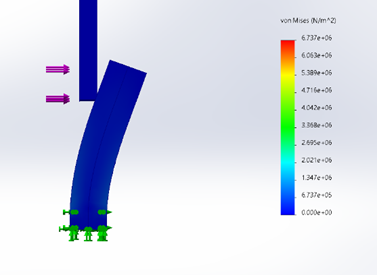
Therefore, I adopted the short screw hole design to optimise this issue. With shorter thread engagement, the base forms a much more rigid fixed fixture. Although the peak stress increases to 6.74 MPa and concentrates at the root, this stress value is fully within the allowable range of the selected material. Most importantly, the short screw hole eliminates base rotation, improves overall structural stiffness, and effectively controls unwanted deflection.
Short Screw Hole
Conclusion
In conclusion, this is a reasonable engineering trade-off. The short screw hole sacrifices partial local stress margin but achieves higher structural stability and rigidity, making it the optimal design for this independent study.