Smart Living Products
ISDN2001/2002: Second Year Design Project
GALVANOMETER PROJECTOR
Gary's Independent Study
Introduction
We set out to build a tabletop interactive laser device. We envisioned a projection system that could turn any daily flat surface into a display. But optical physics got in the way. Through rigorous independent study, we proved that our original tabletop concept would cause irreversible optical distortion due to the steep projection angles. To build a viable product, this research directly forced a pivot in our final design. We moved the device from the table to the rooftop, utilizing top-down perpendicular projection to physically eliminate the distortion. This is the engineering journey of that architecture shift.
HOW IT WORKS: VECTOR SCANNING
Unlike traditional pixel-grid projectors, a galvanometer system traces physical lines in space. The process begins with an ESP32 microcontroller, which calculates X and Y spatial coordinate trajectories in real-time. These digital coordinates are then fed into a high-speed Digital-to-Analog Converter (DAC), which translates them into precise analog voltage signals. Finally, these voltages drive X and Y-axis servo motors that rapidly deflect two mirrors, guiding a single laser beam to instantly draw vector text and patterns across a surface.

PHYSICAL LIMITS & ANGLE DISTORTIONS
Our initial design required the projector to sit flat on a table, projecting upward at an extreme acute angle onto a nearby wall. This independent study sought to systematically measure how these non-ideal projection angles and positions affect text clarity. The findings revealed severe optical bottlenecks. Angled projection induces massive tangent error; as the fast-moving laser beam hits the wall at an angle, the drawn text appears distorted, suffering from severe trapezoidal skew and uneven stretching. Furthermore, because the angled setup forces the beam path to travel different distances, the projection suffers from extreme edge blurriness that software alone cannot fix. Ultimately, tabletop setups with extreme acute angles fundamentally fail to support clear, readable text projection.

WHY DO LASER KEYBOARDS WORK ON TABLES?
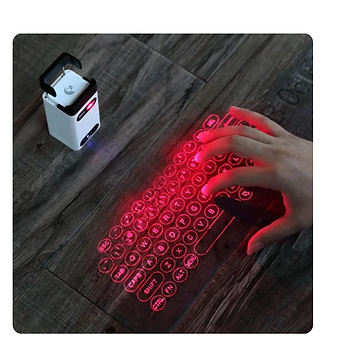
If tabletop angles cause distortion, it is natural to ask how virtual laser keyboards project a perfect grid from the exact same acute angle. The answer lies in the fundamental difference between dynamic and static projection. Our galvanometer system uses moving mirrors to dynamically trace lines point-by-point, meaning the tangent error constantly shifts based on whatever graphic is being drawn. In contrast, laser keyboards do not use moving parts. They rely on a Diffractive Optical Element (DOE), which is a microscopically etched static lens. The manufacturer physically etches this lens with a heavily distorted, reverse-engineered pattern. Because the keyboard operates at one fixed height and angle, the tangent error is entirely pre-calculated. When the laser passes through this inversely distorted lens and hits the table at an extreme angle, the surface geometrically stretches the pattern into a perfect, proportional rectangle. Since our system is dynamic and must project any graphic at any size, we cannot rely on a static, pre-distorted glass lens.
ARCHITECTURE RECONSTRUCTION
and shifted the physical architecture of the product. By moving the device to the ceiling, we achieved a top-down, perpendicular projection arrangement. This hardware reconstruction structurally eliminates the extreme tangent stretch and keeps the entire projection surface within the same focal depth. To account for any minor installation variations, we retain a lightweight 2D pre-distortion matrix (Keystoning) within the ESP32 code to digitally push and pull coordinates, ensuring perfect millimeter precision.
